Swimming alongside ancient sea turtles in the crystal-clear waters around Hamilton Island offers one of the Whitsundays' most magical wildlife encounters. The Hamilton Island Turtle Discovery Tour combines marine education with unforgettable snorkeling experiences, bringing you face-to-face with green turtles and hawksbill turtles in their natural habitat while supporting crucial conservation efforts in the Great Barrier Reef Marine Park.
What is the Hamilton Island Turtle Discovery Tour?
The Hamilton Island Turtle Discovery Tour is a half-day educational snorkeling experience that takes visitors to prime turtle habitat around Hamilton Island, combining wildlife viewing with marine conservation education and hands-on research participation.
Operating from Hamilton Island Marina, this unique tour stands out from typical Hamilton Island activities by focusing specifically on turtle encounters and conservation education. The 3.5-hour experience includes guided snorkeling at two turtle-rich locations, comprehensive briefings about turtle biology and behavior, and participation in citizen science data collection.
Tour participants join marine biologists and experienced guides who share decades of turtle research knowledge while helping locate, identify, and photograph individual turtles. Each sighting contributes to ongoing population studies that track turtle health, migration patterns, and breeding success across the Whitsunday region.
The tour operates year-round with morning departures at 8:30am, returning by 12:30pm. Group sizes are limited to 20 participants maximum, ensuring personalized attention and minimal impact on turtle behavior. All necessary equipment including masks, snorkels, fins, and stinger suits is provided.
Which turtle species will I encounter on this tour?
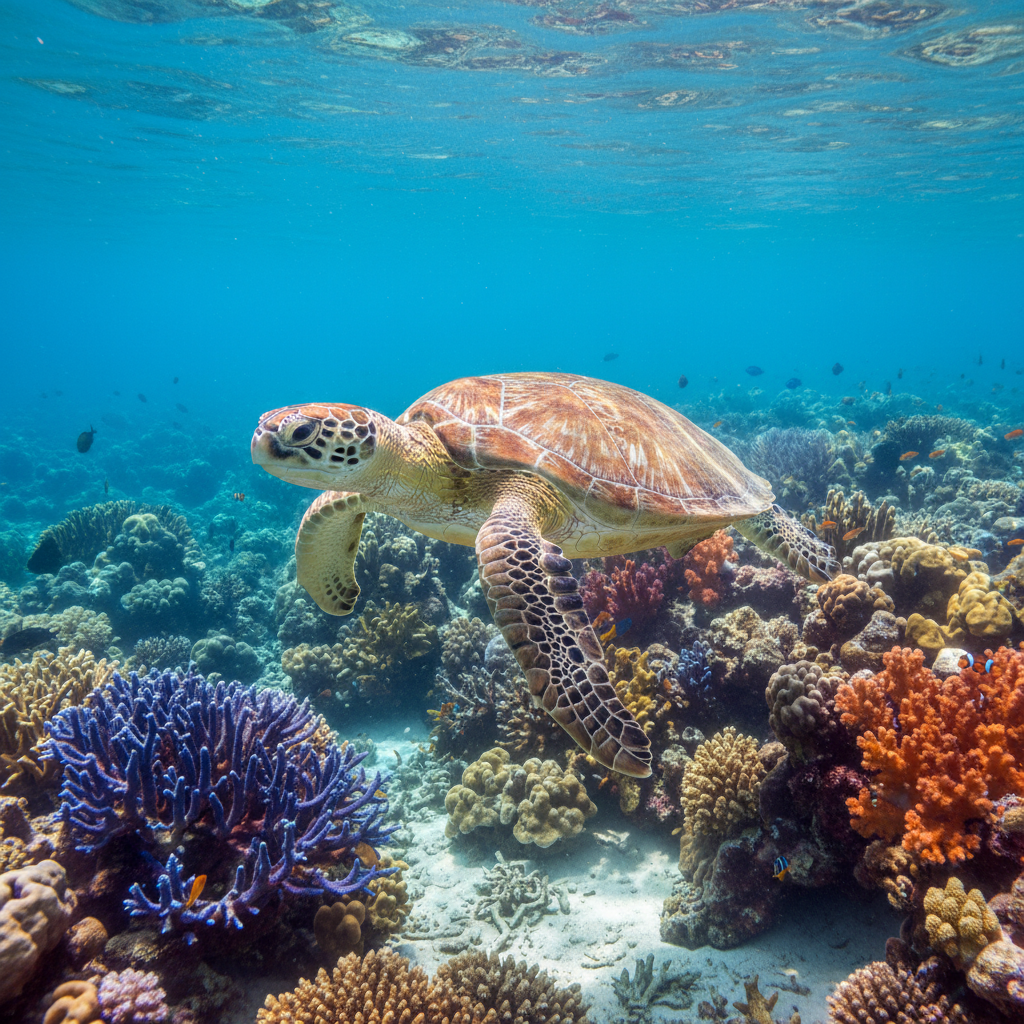
Hamilton Island's waters host primarily green turtles and hawksbill turtles, with green turtles comprising 80% of sightings due to their preference for seagrass beds and calm, shallow waters around the island.
Green turtles (Chelonia mydas) dominate encounters around Hamilton Island, particularly in Catseye Bay and the shallow waters off Resort Side. These herbivorous giants can reach 150cm in length and weigh up to 180kg when fully mature. Adult green turtles display distinctive heart-shaped shells with smooth, olive-brown coloring, though juveniles often show more varied patterns.
Hawksbill turtles (Eretmochelys imbricata) appear less frequently but offer equally spectacular encounters. Distinguished by their pointed beaks, overlapping shell plates, and striking amber-brown coloring, hawksbills typically measure 80-90cm in length. These critically endangered turtles prefer coral reef environments where they feed on sponges and soft corals.
Occasionally, tour participants spot loggerhead turtles (Caretta caretta) passing through Hamilton Island waters during migration periods. These powerful swimmers are identified by their large heads, reddish-brown shells, and robust build, though sightings remain relatively rare compared to resident green and hawksbill populations.
Tour guides maintain detailed identification guides and underwater photography equipment to help document each species encountered, contributing valuable data to the sea turtle research programs operating throughout the Whitsundays region.
Where does the tour visit for the best turtle sightings?
The tour visits two carefully selected locations: Catseye Bay for juvenile green turtles in shallow seagrass beds, and the coral gardens off Hamilton Island's eastern shore for hawksbill turtles and mature green turtles.
Catseye Bay serves as the primary snorkeling location, featuring extensive seagrass meadows in 2-4 meter depths that attract juvenile and sub-adult green turtles. The bay's sheltered position provides calm conditions ideal for novice snorkelers while supporting healthy seagrass growth that forms the foundation of the green turtle diet. Water temperature remains consistently warm year-round, ranging from 22°C in winter to 28°C in summer.
The eastern coral gardens offer the tour's second snorkeling location, where mature green turtles and hawksbill turtles frequent the coral formations in 4-8 meter depths. This site features diverse hard and soft corals, creating habitat complexity that supports the sponges and algae that form hawksbill turtle diets. The area's gentle currents and excellent visibility, often exceeding 20 meters, provide optimal conditions for underwater photography and turtle observation.
Site selection varies based on weather conditions, tidal movements, and recent turtle activity reports. Guides use real-time turtle tracking data and local knowledge to maximize encounter opportunities while ensuring minimal disturbance to feeding and resting behaviors.
Both locations fall within the Great Barrier Reef Marine Park's Habitat Protection Zone, ensuring strict environmental protection and sustainable tourism practices guide all activities.
What conservation work does the tour support?
Tour participants contribute to ongoing turtle research through photo identification, behavioral observation records, and data collection that supports population monitoring and conservation planning across the Great Barrier Reef Marine Park.
The tour operates in partnership with the Reef HQ Great Barrier Reef Aquarium's turtle research program and the Australian Marine Conservation Society. Each turtle encounter generates valuable scientific data through standardized observation protocols that track individual turtle identification, behavior patterns, health indicators, and habitat usage.
Participants learn to photograph turtle faces and shell patterns using underwater cameras provided by the tour operator. These images contribute to the Queensland Turtle Conservation Project's photo identification database, which tracks individual turtles across multiple years to understand migration patterns, growth rates, and population dynamics.
Tour guides demonstrate proper turtle interaction techniques that minimize stress while maximizing learning opportunities. Participants practice the "3-meter rule" for turtle approaches, learn to recognize signs of turtle distress, and understand how human activities impact marine turtle populations.
Revenue from tour operations directly funds turtle research equipment, satellite tracking devices, and education programs delivered to schools across Queensland. The tour operator contributes $10 from each ticket to turtle conservation initiatives, generating approximately $50,000 annually for research and protection efforts.
Educational components cover threats facing marine turtle populations including plastic pollution, boat strikes, fishing gear entanglement, and climate change impacts on nesting beaches and coral reef ecosystems.
Is the turtle tour suitable for children and non-swimmers?
The tour welcomes children aged 5 and above with adult supervision, while non-swimmers can participate using provided flotation devices and staying in shallow areas with dedicated guides offering constant assistance.
Children aged 5-12 receive specialized attention from guides trained in marine education and water safety. Junior participants use child-sized snorkeling equipment and flotation vests, ensuring safety while maintaining mobility needed for effective turtle observation. The tour provides underwater viewing boxes for children uncomfortable with snorkeling, allowing turtle observation from the surface.
Non-swimming adults participate successfully using full-length flotation suits and pool noodles that provide buoyancy without restricting arm movement needed for underwater photography. Dedicated guides remain within arm's reach of non-swimmers throughout water activities, providing constant reassurance and assistance.
The tour vessel features easy water entry points via swim platforms and ladders, accommodating participants with varying mobility levels. Shallow water locations in Catseye Bay average 2-3 meter depths, allowing non-swimmers to touch bottom when needed while still observing turtle behavior.
Safety equipment includes life jackets, emergency flotation devices, first aid supplies, and direct radio communication with Hamilton Island marine rescue services. All guides maintain current CPR and marine rescue certifications, ensuring comprehensive safety coverage for participants of all skill levels.
Educational components adapt to different age groups, with simplified explanations and hands-on activities keeping younger participants engaged while delivering age-appropriate conservation messages.
How much does the Hamilton Island Turtle Discovery Tour cost?
The Hamilton Island Turtle Discovery Tour costs $145 AUD for adults and $95 AUD for children (5-15 years), including all equipment, marine biologist guides, educational materials, and conservation contributions.
Adult pricing at $145 AUD includes comprehensive snorkeling equipment (mask, snorkel, fins, wetsuit, stinger suit), underwater cameras for turtle photography, educational materials, morning tea with locally sourced refreshments, and transportation between snorkeling sites aboard the tour vessel.
Children's pricing at $95 AUD covers the same inclusions with appropriately sized equipment and additional safety measures including mandatory flotation devices and increased guide supervision ratios. Family packages offer $50 AUD savings for groups including two adults and two children.
Group discounts apply for bookings of 8 or more participants, reducing adult pricing to $125 AUD and children's pricing to $80 AUD. School group rates offer further reductions to $70 AUD per student for educational visits including 10 or more participants.
Pricing includes goods and services tax (GST), marine park permits, insurance coverage, and environmental management fees. No additional costs apply except optional underwater photography packages ($35 AUD) that provide professional images of turtle encounters taken by guides using specialized underwater photography equipment.
Compared to other turtle tours in the Whitsundays, Hamilton Island's pricing reflects the specialized educational focus, smaller group sizes, and direct conservation contributions that distinguish this experience from general snorkeling tours.
What should I bring on the turtle discovery tour?
Bring reef-safe sunscreen, a towel, hat, water bottle, and waterproof bag for personal items, while the tour provides all snorkeling equipment, stinger suits, underwater cameras, and safety gear.
Essential personal items include reef-safe sunscreen (zinc oxide or titanium dioxide formulations only) to protect marine ecosystems, a large towel for post-snorkeling warmth, and a wide-brimmed hat for sun protection during boat travel. Comfortable swimwear and quick-dry clothing ensure comfort throughout the experience.
Waterproof storage bags protect phones, cameras, wallets, and medications during water activities. The tour vessel provides secure storage areas, but individual waterproof protection offers peace of mind for valuable items.
Hydration remains crucial during 3.5-hour marine activities, though the tour provides bottled water and refreshments. Participants with specific dietary requirements should bring additional snacks, particularly those with allergies or diabetes requiring regular food intake.
Prescription glasses wearers should consider contact lenses or prescription diving masks (available for rent at $15 AUD). The tour operator provides over-the-counter anti-seasickness tablets, though participants prone to motion sickness should take preventive medication 30 minutes before departure.
Items to leave behind include regular sunscreen containing oxybenzone or octinoxate (harmful to coral reefs), excessive jewelry that might catch on equipment, and single-use plastics that conflict with conservation messaging.
Weather-appropriate clothing adapts to seasonal conditions, with light long-sleeved shirts recommended during stinger season (November-May) and warm layers suggested during cooler months (June-August).
When is the best time of year for turtle encounters?
Turtle encounters occur year-round around Hamilton Island, with peak activity during warmer months (October-April) when turtles are most active, though winter months offer calmer waters and excellent visibility.
Summer months (December-February) provide optimal turtle activity with water temperatures reaching 28-30°C, encouraging active feeding and increased surface behavior. Green turtles demonstrate peak activity during these warmer periods, spending more time in shallow seagrass beds easily accessible to snorkelers.
Autumn (March-May) offers excellent conditions combining warm water temperatures with reduced weather volatility. This period sees continued high turtle activity while avoiding peak tourist crowds, providing more intimate wildlife encounters. Stinger season considerations require protective suits but don't limit turtle observation opportunities.
Winter months (June-August) feature calmer sea conditions and exceptional underwater visibility often exceeding 25 meters, ideal for photography and detailed turtle observation. Though turtle activity decreases slightly with cooler 22-24°C water temperatures, sighting rates remain high with turtles gathering in warmer shallow areas.
Spring (September-November) marks the beginning of increased turtle activity as waters warm, coinciding with excellent weather conditions and comfortable air temperatures. This period offers optimal combinations of turtle activity, weather stability, and comfortable touring conditions.
Breeding season considerations affect turtle behavior from November-February when some individuals focus on mating activities rather than feeding, though this creates opportunities to observe unique reproductive behaviors.
How does the tour help me learn about turtle conservation?
Expert marine biologist guides provide comprehensive education covering turtle biology, lifecycle, threats, conservation successes, and individual actions that support population recovery through interactive presentations and hands-on research participation.
Pre-snorkeling briefings cover essential turtle biology including the six species found in Australian waters, their distinctive identification features, feeding habits, and migration patterns. Guides explain how green turtles transition from omnivorous juveniles to herbivorous adults, while hawksbill turtles maintain specialized sponge-based diets throughout their lives.
During turtle encounters, guides demonstrate non-invasive observation techniques while explaining individual turtle behaviors. Participants learn to interpret turtle body language, recognize feeding activities, identify gender differences in mature individuals, and understand social interactions between multiple turtles.
Conservation education addresses major threats including plastic pollution statistics (revealing that 50% of sea turtles have consumed plastic debris), boat strike injuries, fishing net entanglement impacts, and climate change effects on nesting beach temperatures that determine hatchling gender ratios.
Success stories highlight positive conservation outcomes including population recovery in some regions, effectiveness of marine protected areas, and impact of community education programs. Participants learn about satellite tracking research revealing turtle migration routes spanning thousands of kilometers across the Pacific Ocean.
Practical conservation actions include proper plastic disposal, choosing reef-safe sunscreens, supporting sustainable seafood choices, and participating in beach clean-up activities. Guides provide resources for continued learning and involvement in turtle conservation efforts after the tour.
What makes this tour different from other turtle experiences?
This specialized turtle-focused tour combines marine biology expertise with citizen science participation and conservation education, unlike general snorkeling tours that include turtles as incidental wildlife encounters.
The tour's scientific foundation sets it apart through partnerships with established research institutions and participation in long-term population monitoring programs. Unlike standard wildlife tours, participants contribute meaningful data to ongoing conservation efforts through systematic observation protocols and photographic documentation.
Group size limitations to 20 participants maximum ensure personalized attention and minimal environmental impact, contrasting with larger tour operations that may accommodate 40-60 participants. This intimate scale allows detailed individual instruction in turtle identification and photography techniques.
Educational depth exceeds typical wildlife tours through comprehensive pre-tour briefings, real-time interpretation during encounters, and detailed post-tour discussions about conservation challenges and solutions. Marine biologist guides provide university-level expertise typically unavailable on general snorkeling tours.
Conservation contribution transparency distinguishes this experience, with clear documentation of how tour fees support specific research projects and protection initiatives. Participants receive follow-up communications about research outcomes and conservation successes their participation helped achieve.
Location selection prioritizes turtle habitat quality over scenic appeal, ensuring optimal wildlife encounters rather than focusing solely on coral reef aesthetics. This approach maximizes turtle sighting opportunities while supporting educational objectives.
Equipment quality includes specialized underwater cameras and identification guides unavailable on standard snorkeling tours, enhancing learning opportunities and documentation capabilities for participants.
Ready to experience the magic of swimming with sea turtles while contributing to their conservation? Book your Hamilton Island Turtle Discovery Tour through Airlie to Whitehaven, your trusted platform for authentic Whitsundays experiences. Our local expertise ensures you'll connect with the most reputable tour operators while supporting genuine conservation efforts that protect these ancient marine creatures for future generations.