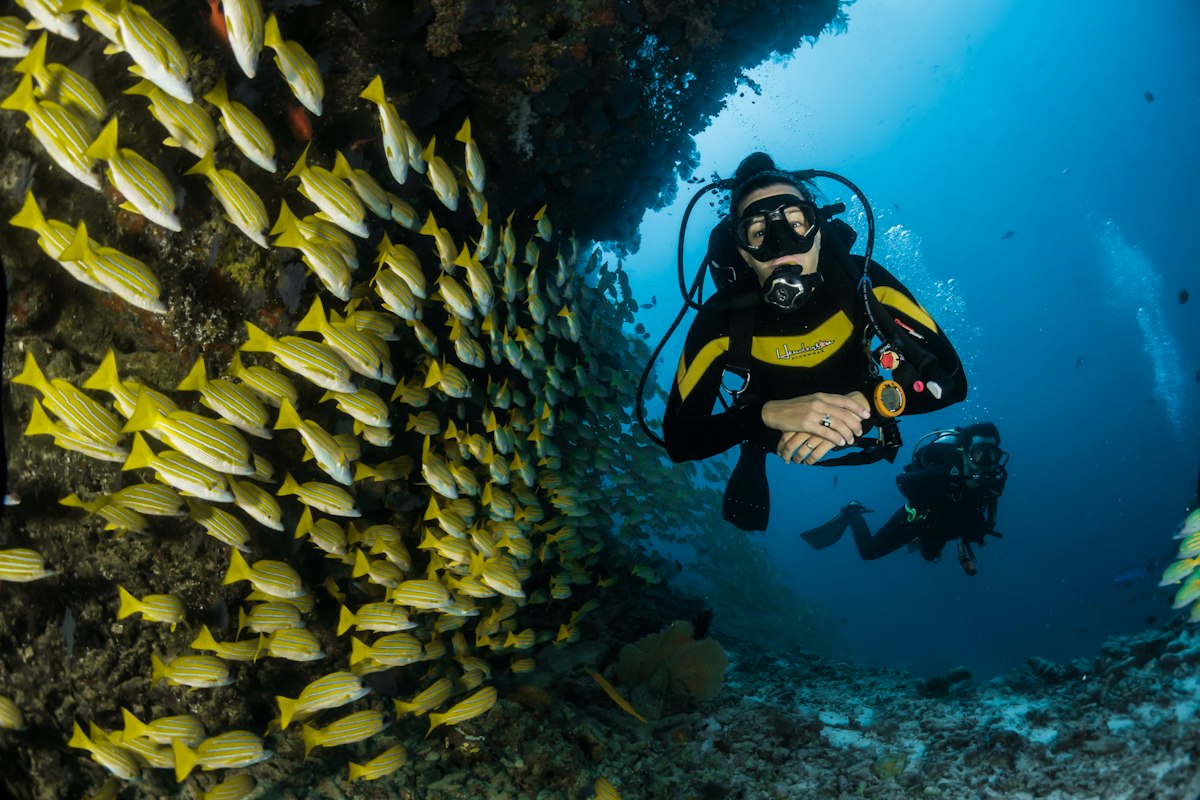
The Whitsundays offer some of Queensland's most accessible diving experiences, from beginner-friendly coral gardens to dramatic wall dives teeming with marine life. Unlike the outer Great Barrier Reef, many Whitsundays dive sites sit in sheltered waters between the islands, making them perfect for new divers or those wanting to explore without long boat rides. The region's 74 islands create a diverse underwater landscape where you'll encounter reef sharks, sea turtles, giant grouper, and pristine hard and soft coral formations.
Where are the best scuba diving sites in the Whitsundays?
The top Whitsundays dive sites include Manta Ray Bay (Hamilton Island), Blue Pearl Bay (Hayman Island), Catseye Beach (Hamilton Island), and Bait Reef. These sites offer visibility ranging from 15-25 metres, depths from 5-18 metres, and diverse marine ecosystems perfect for all certification levels.
Manta Ray Bay on Hamilton Island's southern tip ranks as the region's premier dive destination. This protected site features a maximum depth of 18 metres, making it suitable for Open Water divers, with consistent visibility between 20-25 metres. The bay's boulder formations create swim-throughs and overhangs where you'll spot white-tip reef sharks resting during the day. Regular sightings include giant trevally, coral trout, and during winter months, juvenile manta rays feeding in the shallows.
Blue Pearl Bay at Hayman Island offers the most spectacular coral diversity in the Whitsundays. The site extends from 3-15 metres depth, with pristine staghorn and table coral formations covering the sandy bottom. Marine life includes schools of barracuda, sweetlip emperor, and the occasional green sea turtle. The bay's protection from prevailing winds ensures calm conditions year-round, with water temperatures ranging from 22°C in winter to 29°C in summer.
Catseye Beach on Hamilton Island provides excellent shore diving opportunities. Entry is directly from the beach, eliminating boat transfer costs and time constraints. The site features a maximum depth of 8 metres, perfect for newly certified divers or those completing training dives. Regular marine encounters include wobbegong sharks, blue-spotted stingrays, and schools of tropical fish species.
Bait Reef, located 39 nautical miles from Airlie Beach, represents the closest Great Barrier Reef access point. This outer reef location offers wall diving with dramatic drop-offs exceeding 30 metres depth. Advanced Open Water certification is recommended due to stronger currents and deeper profiles. Marine life includes pelagic species like Spanish mackerel, grey reef sharks, and during whale season (June-September), humpback whale encounters.
What scuba diving courses are available in the Whitsundays?
Whitsundays dive operators offer PADI Open Water certification courses (4-day programs, $695-$795), Advanced Open Water courses (2-3 days, $450-$550), and specialty courses including deep diving, underwater photography, and rescue diver training through accredited dive centers.
PADI Open Water certification represents the entry-level qualification, allowing diving to 18 metres depth with a certified buddy. The 4-day course includes classroom theory, confined water training in swimming pools, and four open water dives at local sites. Course fees typically range $695-$795, including all equipment, certification materials, and boat transfers to dive sites.
Advanced Open Water certification extends diving privileges to 30 metres and introduces specialty diving techniques. The 2-3 day course includes five adventure dives covering deep diving, underwater navigation, and three elective specialties chosen from options like fish identification, underwater photography, or wreck diving. Course costs range $450-$550, assuming existing Open Water certification.
Specialty courses allow certified divers to develop specific skills. Popular options include deep diving certification (diving to 40 metres, 2-day course, $350-$450), underwater photography certification (2-day course, $400-$500 including camera equipment), and rescue diver training (3-day intensive course, $550-$650). These specialties count toward PADI Divemaster certification for those pursuing professional qualifications.
Try-scuba experiences cater to non-certified participants wanting to experience breathing underwater. These introductory programs include pool-based training and one shallow dive (maximum 6 metres) under direct instructor supervision. Sessions last approximately 3 hours and cost $150-$200, including all equipment and basic instruction.
How much do Whitsundays diving tours cost?
Whitsundays diving tours range from $180-$220 for two-dive day trips to local sites, while Great Barrier Reef excursions cost $280-$350 per person. Multi-day liveaboard diving experiences range $450-$650 per person per day, including accommodation, meals, and unlimited diving.
Local reef diving day trips offer the most economical diving option. These tours visit 2-3 sites around the Whitsunday Islands, typically including Manta Ray Bay, Blue Pearl Bay, or Catseye Beach. Prices range $180-$220 per certified diver, including equipment rental, boat transfers, and light lunch. Tours depart Abel Point Marina at 8:30 AM, returning approximately 4:30 PM.
Great Barrier Reef diving excursions represent a premium experience with significantly higher costs. Full-day trips to Bait Reef or Hardy Reef cost $280-$350 per person, including three dives, equipment, gourmet lunch, and snorkeling options for non-diving companions. These tours require 2-hour boat transfers each way, departing 7:30 AM and returning 6:00 PM.
Liveaboard diving experiences provide the ultimate Whitsundays underwater adventure. 2-day/1-night trips cost $450-$550 per person, including accommodation, all meals, equipment, and up to 6 dives. 3-day/2-night experiences range $650-$850 per person, visiting remote sites impossible to reach on day trips. Vessels accommodate 8-16 passengers with shared cabin arrangements.
Equipment rental typically costs $40-$50 per day for full gear (BCD, regulator, wetsuit, fins, mask). Many operators include basic equipment in tour prices but charge extra for premium gear like underwater cameras ($80-$100 per day) or diving computers ($30-$40 per day).
What marine life can you see diving in the Whitsundays?
Whitsundays diving reveals white-tip and grey reef sharks, green sea turtles, manta rays, giant grouper, coral trout, and schools of barracuda. Seasonal highlights include humpback whales (June-September), wobbegong sharks year-round, and juvenile manta rays during winter months at cleaning stations.
Shark encounters represent the Whitsundays' most exciting diving attraction. White-tip reef sharks rest in caves and overhangs during daylight hours, particularly at Manta Ray Bay and Blue Pearl Bay. These docile sharks reach 1.6 metres length and pose no threat to divers. Grey reef sharks patrol outer reef locations like Bait Reef, displaying more active hunting behavior but remaining non-aggressive toward humans.
Sea turtles frequent Whitsundays dive sites year-round, with green sea turtles most commonly observed. These marine reptiles reach 1.2 metres shell length and can hold their breath for 2-3 hours while foraging on sea grass beds. Hawksbill turtles occasionally appear at sites with hard coral formations, identifiable by their distinctive hooked beaks used for extracting sponges from coral crevices.
Giant grouper, locally called Queensland grouper, represent the region's largest fish species. These impressive predators reach 2.7 metres length and 400 kilograms weight, often displaying curiosity toward divers rather than fear. Regular sightings occur at Bait Reef and deeper Whitsundays sites, where grouper establish cleaning stations visited by smaller fish species.
Seasonal marine life adds excitement to diving schedules. Humpback whales migrate through Whitsundays waters June through September, with underwater encounters possible during outer reef diving. Whale songs carry for kilometers underwater, creating unforgettable acoustic experiences. Manta rays visit cleaning stations during winter months (June-August), particularly at Manta Ray Bay's northern bommie.
When is the best time to scuba dive in the Whitsundays?
May through September offers optimal Whitsundays diving conditions with water temperatures 22-26°C, minimal rainfall, southeast trade winds creating calm conditions, and 20-25 metre visibility. Whale season (June-September) adds seasonal marine life encounters to diving experiences.
Winter months (May-September) provide the most consistent diving conditions. Water temperatures range 22-26°C, requiring 3-5mm wetsuits for thermal protection during longer dives. Southeast trade winds average 10-15 knots, creating calmer sea conditions and improved visibility ranging 20-25 metres at most sites. Rainfall averages 40-60mm monthly, minimizing freshwater runoff that can reduce underwater visibility.
Summer diving (October-April) presents warmer water temperatures (26-29°C) but increased rainfall and potential tropical weather systems. Water temperatures may require only 2-3mm wetsuits or lycra suits for protection. However, rainfall averages 150-300mm monthly, creating freshwater runoff that can reduce visibility to 10-15 metres at nearshore sites.
Stinger season (November-May) requires additional safety precautions for diving activities. Box jellyfish and Irukandji jellyfish inhabit coastal waters during these months. Reputable dive operators provide full-coverage stinger suits and avoid high-risk areas. Snorkeling activities face similar seasonal considerations but with greater surface exposure risks.
Cyclone season (November-April) can disrupt diving schedules through tour cancellations and reduced visibility. While direct cyclone strikes remain rare, associated weather systems create surge conditions and increased rainfall affecting dive site access and underwater conditions.
What diving certification do you need for Whitsundays sites?
Most Whitsundays dive sites require PADI Open Water certification (or equivalent) allowing 18-metre depth limits. Advanced Open Water certification is recommended for outer Great Barrier Reef sites and deeper locations requiring 30-metre depth capabilities and improved buoyancy control skills.
Open Water certification represents the minimum qualification for independent diving in the Whitsundays. This certification allows diving to 18 metres depth with a certified buddy, covering all major island dive sites including Manta Ray Bay, Blue Pearl Bay, and Catseye Beach. The certification requires completion of classroom theory, confined water training, and four open water checkout dives.
Advanced Open Water certification extends diving privileges and enhances safety for challenging sites. This certification permits 30-metre depth limits, essential for outer reef locations like Bait Reef where dramatic walls exceed Open Water depth restrictions. Advanced certification also develops skills in deep diving, underwater navigation, and specialty areas improving overall diving competency.
Professional certifications including Divemaster and Instructor ratings allow leading diving activities in the Whitsundays. Many operators hire certified professionals for seasonal positions, particularly during peak tourism periods (April-October). Requirements include rescue diver certification, 40+ logged dives for Divemaster, and 100+ dives for instructor certification.
Try-scuba programs accommodate non-certified participants through direct instructor supervision. These introductory experiences limit depth to 6 metres and require continuous instructor contact. While perfect for testing diving interest, try-scuba programs don't provide certification or independent diving privileges.
How do you book diving tours from Airlie Beach?
Book Whitsundays diving tours through certified operators departing Abel Point Marina or Shute Harbour. Advanced booking is essential during peak season (April-October), with online reservations offering discounted rates compared to walk-in pricing. Medical questionnaires and certification verification are required.
Tour operators require medical questionnaire completion before diving activities. Standard forms ask about recent illnesses, medications, and conditions affecting diving safety including heart problems, respiratory issues, or pregnancy. Positive responses may require medical clearance from qualified physicians before diving participation.
Certification verification is mandatory for all diving activities. Operators accept PADI, NAUI, SSI, or equivalent certification cards issued by recognized training agencies. Certification cards must be current and match depth limits for planned diving sites. Forget your certification card, and you'll need to complete try-scuba programs instead.
Group bookings (6+ participants) typically receive 10-15% discounts from standard pricing. Corporate groups, dive clubs, or family bookings can negotiate package deals including accommodation and multiple-day diving experiences. Advanced notice (2+ weeks) improves group rate availability and tour scheduling flexibility.
Cancellation policies vary between operators but typically allow full refunds 48-72 hours before departure. Weather cancellations result in full refunds or rescheduling options. Travel insurance covering diving activities is recommended, particularly for international visitors whose domestic policies may exclude scuba diving coverage.
What should beginners know before diving in the Whitsundays?
Beginners should complete Open Water certification before arrival, practice buoyancy control skills, bring certification cards and logbooks, and choose protected island sites over challenging outer reef locations. Local briefings cover site-specific hazards, marine life, and emergency procedures.
Pre-trip preparation significantly improves diving enjoyment and safety. Complete Open Water certification in your home location where classroom time isn't constrained by vacation schedules. Practice essential skills including mask clearing, regulator recovery, and buoyancy control in familiar environments before tackling unfamiliar sites.
Essential equipment includes certification cards, logbooks documenting diving experience, and personal gear if owned. While operators provide rental equipment, personal masks and fins offer better fit and comfort. Prescription mask inserts accommodate vision correction needs and eliminate contact lens complications underwater.
Site selection impacts beginner diving success. Start with protected locations like Catseye Beach or Blue Pearl Bay before attempting outer reef sites. These sheltered locations offer predictable conditions, shorter boat transfers, and easier entry/exit procedures compared to more challenging offshore locations.
Local diving procedures may differ from certification training. Whitsundays operators conduct comprehensive site briefings covering entry/exit techniques, underwater navigation, marine life identification, and emergency procedures. Hand signals may include additional gestures for local marine life or specific hazards not covered in standard training.
Buddy system protocols remain essential for safe diving. Communicate experience levels honestly with dive guides and buddies. Never exceed certification limits or attempt skills beyond current training. Diving accidents often result from overconfidence or peer pressure rather than equipment failures or environmental hazards.
Ready to explore the underwater world of the Whitsundays? Airlie to Whitehaven connects you with certified dive operators offering everything from beginner courses to advanced multi-day diving adventures. Our platform features detailed tour comparisons, real customer reviews, and instant booking confirmations to help you find the perfect diving experience. Whether you're earning your first certification or seeking remote reef encounters, book your Whitsundays diving adventure today and discover why this region ranks among Australia's premier diving destinations.